
COMMUNITY DRINKING WATER PROJECT
Operation and Maintenance:
By providing on-going operations, maintenance support and water quality monitoring for a period of at least 10 years, these Water Health Schools become a reliable source for WHO quality water for these communities.
The key to long term sustainability is to ensure that the project itself generates revenues to maintain itself. An affordable user charge for operation and maintenance of the water purification system enables long term sustainability of the project thus ensuring that the people get safe water for a long time.
Delivery Mechanism:
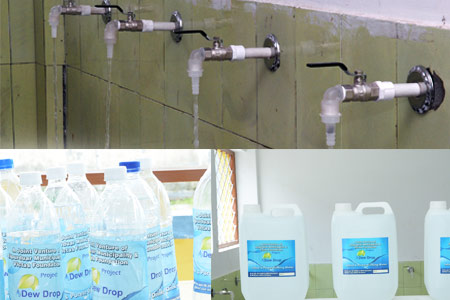
The water is collected from the “Project Dew Drop” Water Health Schools in 20/10-liter cans which will be provided by Project Dew Drop. Victas Foundation with the help of concerned authority directly or through a partner or local entrepreneur or self help group will establish a delivery mechanism whereby safe water is to be delivered to nearby places. The cost of delivery will be extra depending of the distance of the household.
Quality of Water:
 “Project Dew Drop” provides SAFE drinking water free of bacterial and microbiological contamination. “Project Dew Drop” has a stringent quality checks and audits in place system to ensure the quality of treated water and services provided to the communities in which we operate.
Community Mobilization and Motivation
Victas Foundation mobilizes and motivates the beneficiary communities in the villages, before initiating any type of water projects. BV ensures that at least 70 to 80% of the families in the villages are represented at the village level motivational meetings for the water purification and over head tank projects.
The number of attendees is an indicator of a felt need by the community and their willingness to participate & contribute towards the program. The community representatives take up the task of mobilizing the villagers by involving leaders of gram panchayat, farmers, women and youth. During these meetings, communities are sensitized by BV staff on unity and active participation in the project execution. They also explain the activities involved, community contributions, action plan, rules and regulations of the projects and roles and responsibilities of different stake holders.
Project Design and Technology
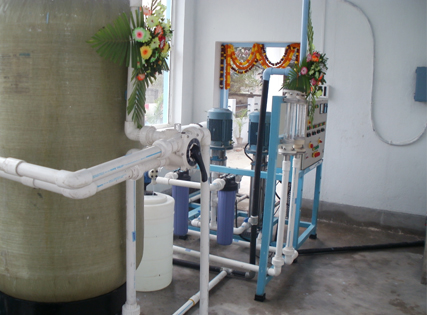
The water purification machines and the over head tank capacities are designed based on the population size of the respective villages. General consideration is for a capacity of 250, 500, 1000 and 2000 LPH (liters per hour) for water purifying machines, and 40,000, 60,000 and 1,00,000 litres of storage capacity for over head tanks.
Quality Test for Purified Water
It is essential to monitor periodically the quality of water produced by the community water purification projects. Therefore, Victas Foundation has instructed the project committees to send purified water samples periodically to the water testing lab established at Victas Foundation head quarters. The communities are being provided with required technical guidance to ensure that the water quality is maintained. Victas Foundation has not only trained the staff with technical knowledge but also sends the technical team to the villages whenever quality problems arise.
NGOs visit the water purification projects of Victas Foundation have attracted large number of NGOs from across the country and abroad who visited the project areas and interacted with local communities to understand the methodology and the effectiveness of Victas Foundation’s interventions.
Bore Wells
Victas Foundation has brought together the rural communities around the common issue of clean water. Digging bore wells was one of the reliable and cost-effective solutions for the water needs of people. Victas Foundation took up drilling bore wells and installing hand pumps as per the need and community participation. Thus far, we have facilitated drilling and installation of over 56 bore wells in India.
Through this program Victas Foundation has taken a project to reach two million people to have access to water for drinking and domestic use by 2017. During the year 2013-14, Victas Foundation has dug and installed 3 bore wells.
Overhead Tanks
Reaching potable water to the door step of the rural poor: The tube wells have made water available for people b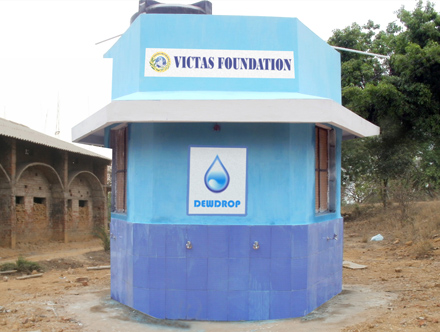 ut it still required women to walk long distances to fetch water. Victas Foundation is working on in using technology to pumping water to the elevated overhead tanks and supplies it to homes through gravitational force. Victas Foundation have has taken project of 60 overhead tanks and are reaching to over 50000 people. During the year 2013-14, two overhead tanks were constructed reaching water to 450 families in two villages.
Safe Drinking Water
As the ground water, which is the main source of drinking water, is becoming scarce day by day; the hardness of water and fluoride content is on the constant rise causing serious health problems to the people in the rural areas. While the governments have largely focused on providing access to water they have neither a policy nor any system to address the issue of safe drinking water to the rural poor. The calling need of the hour in the region is safe drinking water. Victas Foundation that has pioneered taking care of the water needs of people in the last three decades took it as an opportunity to address the aspiration of people for purified drinking water and developed a sustainable program around which several other development activities could be organized.
Community owned Water Purification Plants
Victas Foundation initiated the community owned and managed water plants in the year 2009. This initiative reached a milestone of installing 24 water purification plants in the year 2013-14, reaching safe drinking water to over a million people
Communities find collective strength in addressing their water needs
Victas Foundation has focused much on its core objectives of ensuring safe drinking water to the rural masses in the last one year 2013-14 In fact addressing the water needs of the rural communities has been the key program of Victas Foundation since one decade.
True to the motto of ‘Helping people to help themselves’ Victas Foundation ensures that all the water programs are owned, operated and managed by the beneficiary communities.
Capacity Building Programs for the VSS Committees
Victas Foundation staff played catalyst role in supporting the WPP committees by empowering them with knowledge and skills required for the successful management of the Plants. During the year 2011-12 staff have conducted 126 motivational meetings, made 1825 monitoring visits, organised 579 monthly meetings of the committees and 121 Annual General Body meetings. Apart from this 722 committee members attended general training and 445 members attended operation and accounts trainings. 128 members attended the training on ‘Environment Protection’.
Purified water improves health and productivity in Samudrala village
Kaluseria village is located at a distance of 50 Km from the Sundargarh district head quarters. The village has about 500 families belonging to various castes and religions. Entire village depends on agriculture for their livelihood. Majority of the people are small and marginal farmers earning meagre incomes. Villagers have been suffering from fluoridise since many years as the major drinking water source of the village contains 2 PPM fluoride which is above the permissible limits for consumption.
 After learning that Victas Foundation is supporting water purification projects in fluoride affected villages, the villagers approached for help. Victas Foundation analysed the need of the people and assessed their participation strength. After people accepted the community ownership criteria of Victas Foundation, the project to install 1000 litters per hour capacity machine in the village was approved.
Thereafter, villagers have formed a committee and collected necessary local contributions from the villagers in the form of membership fee. Out of 500 families in the village, 400 families took the membership in the first phase itself. The project committee has formulated necessary rules and regulations for the project maintenance such as price of water to the members, water supply timings, prepaid card system, monthly committee meetings etc.
The project is providing employment to 2 people i.e an operator and an accountant. The staffs works under the supervision of the water plant committee. They maintain the records up to date and submit accounts to the committee. They are very transparent to all their members with respect to financial matters. All the committee members work voluntarily.
They meet regularly every month to monitor the functioning of the project. With the help of the project staff they take care of the machine’s maintenance and regular supply of water without a break even on a single day. As the members are using prepaid cards to get the water supply, financial transactions are always clear and up-to-date.
As the purified water is used by every family in the village, there is a clear difference seen in their health. They don’t suffer from water borne disease problem anymore. Even the occurrence of water born diseases has been reduced largely. During an evaluation visit by Victas Foundation to the village an interesting fact surfaced. The Rural Medical Practitioner (RMP) confessed that he lost 50% of income due to the water purification project of Victas Foundation in the village. As people are using safe water their health is now protected. Villagers have become healthy and more productive.
After succeeding with the water purification plant project the ‘Drinking Water Committee is very enthusiastic about taking up many other development activities in their village.